
Free Workbooks
Free AI Workbooks: Practise Every Lesson on Paper
Every ai2hired lesson comes with a printable workbook. Read the lesson again, test yourself, practise, and prepare the interview questions it leads to.
- 8 workbooks out
- 221 pages of practice
- Free with a free account
What Every Workbook Holds
The same six parts in every workbook, so you always know where to find what you need.
The Lesson, Step by Step
Everything the video teaches, written out so you can read it at your own pace and come back to it.
Check Yourself
Short questions after each part, so you know you understood before you move on.
Exercises With Answers
Practice you do on paper or at the keyboard, with worked answers at the back.
A Mini Project
One small, real task that uses what the lesson taught, the kind you can show.
Interview Questions
The questions this lesson prepares you for, with model answers in plain words.
Further Reading
The books and official texts to go deeper, chosen for this lesson.
Workbooks, Season by Season
Open a season to see its workbooks, in course order. Each workbook downloads from its lesson page once you are signed in, and stays in My Workbooks.
S0Season 0: Start HereUnderstand the AI job landscape, choose a target role, and use AI assistants and prompting with judgment.8 of 8 workbooks
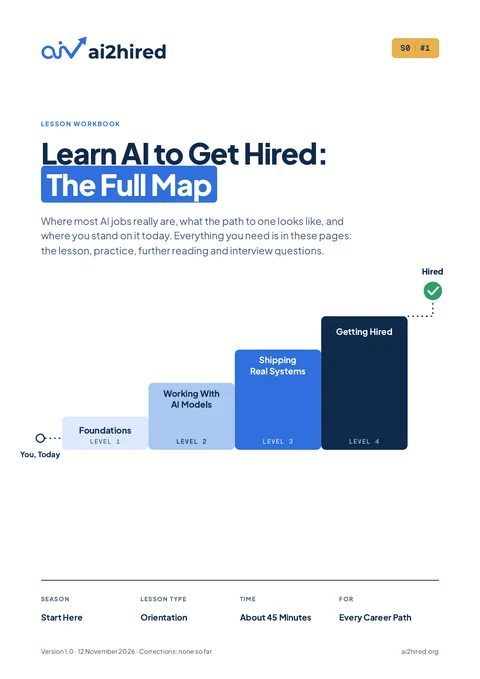
Learn AI to Get Hired: The Full Map
The full map of ai2hired: from zero technical background to your AI job interview, in 18 seasons built from what real AI job ads ask for.
PDF20 pagesVersion 1.012 November 2026
Peek Inside
Check Yourself
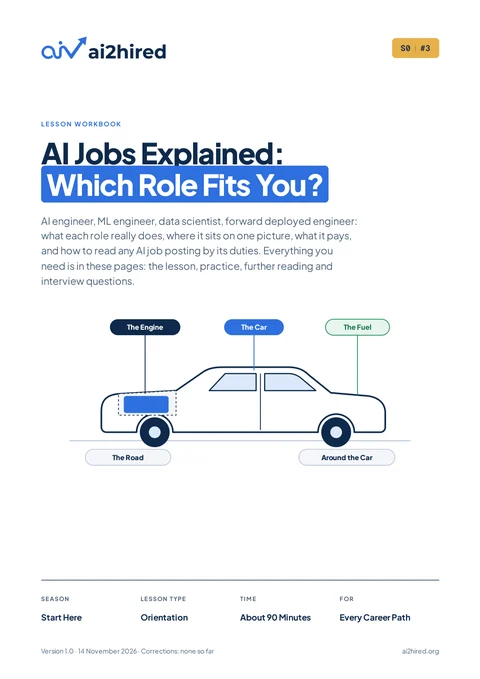
In the engine and car picture, who builds the engine?
- AI engineers
- Researchers
- Recruiters
Where do most AI jobs work?
- On the engine: building new models
- On the car: building the product around the model
Interview Question
What's the difference between building an AI model and building an AI product?
Model answerThe model is the engine: researchers build it, with deep math, often with an advanced degree. The product is the car around it: the app or tool people actually use, built by AI engineers and the roles around them. Most AI jobs are on the product side, which is where I'm aiming.
Word for word from the workbook. The answers to Check Yourself, and everything else, are inside.
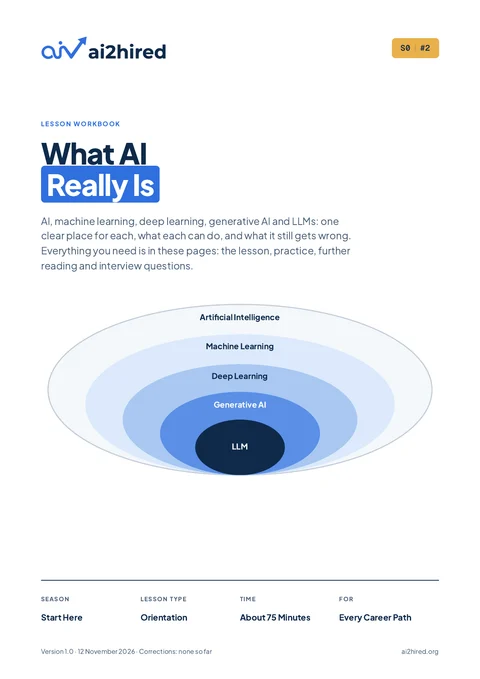
What AI Really Is: AI vs Machine Learning vs LLMs
AI vs machine learning vs deep learning vs generative AI vs LLMs, explained from zero: five words in one picture, and what AI still gets wrong.
PDF27 pagesVersion 1.012 November 2026
Peek Inside
Check Yourself
Which word is the biggest circle of the family?
- Machine learning
- Artificial intelligence
- Large language model
Why did rule-based AI hit a wall?
- Computers were too slow
- Every new trick needed a new rule
- Nobody wanted it
Interview Question
What's the difference between AI, machine learning and deep learning?
Model answerThey are nested. AI is the umbrella: machines doing tasks that seem to need intelligence. Machine learning is the part of AI that learns from examples instead of hand-written rules. Deep learning is the part of machine learning that uses many layers.
Word for word from the workbook. The answers to Check Yourself, and everything else, are inside.
AI Jobs Explained: Which Role Fits You?
AI engineer vs ML engineer vs data scientist vs forward deployed engineer: what each AI role really does, what it pays, and how to read a job posting.
PDF28 pagesVersion 1.014 November 2026
Peek Inside
Check Yourself
Which side of AI work has most of the jobs?
- Training giant models
- Deploying models in products
Who invents new kinds of models?
- The ML researcher
- The AI engineer
- The data scientist
Interview Question
Why do you want this role, and not a neighboring one?
Model answerI read the duties, not just the title. This role is about building applications on ready-made models, which is what I enjoy most. I'm less drawn to research, which is about inventing new models, or to pure data engineering.
Word for word from the workbook. The answers to Check Yourself, and everything else, are inside.
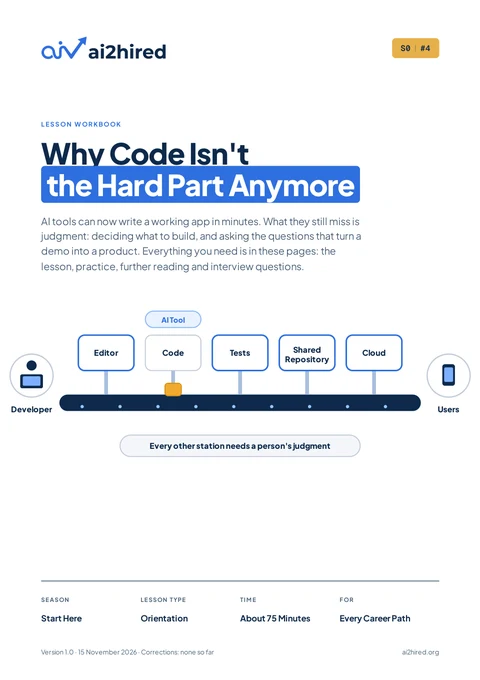
Why Code Isn't the Hard Part Anymore
AI coding tools write working apps in minutes.
PDF28 pagesVersion 1.015 November 2026
Peek Inside
Check Yourself
What is an AI coding tool?
An open question: you write your own answer.
Name two things AI coding tools can do besides writing new code.
An open question: you write your own answer.
Interview Question
How do you use AI coding tools in your work?
Model answerFor the simple, well-defined parts: a first draft of code, documentation, explaining unfamiliar code. Before I ask, I decide what should be built and list the edge cases. Then I read what comes back and test it. I own the result, not the tool.
Word for word from the workbook. The answers to Check Yourself, and everything else, are inside.
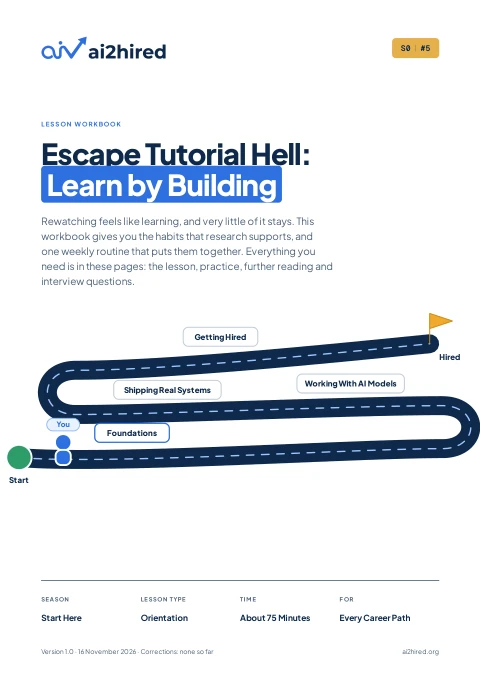
Escape Tutorial Hell: Learn by Building
Why you can watch hours of tutorials and still freeze at a blank page, and the weekly routine that makes learning stay: retrieval, spacing and building first.
PDF28 pagesVersion 1.016 November 2026
Peek Inside
Check Yourself
What is tutorial hell?
An open question: you write your own answer.
Complete: “The feeling that you've learned something only because it looks familiar is the ______.”
An open question: you write your own answer.
Interview Question
How do you learn a new tool or topic quickly?
Model answerIn short sessions, and I build something small with it straight away, before I read more. After each session I write five minutes of notes in my own words, and once a week I quiz myself with everything closed. I only go back to what I got wrong.
Word for word from the workbook. The answers to Check Yourself, and everything else, are inside.
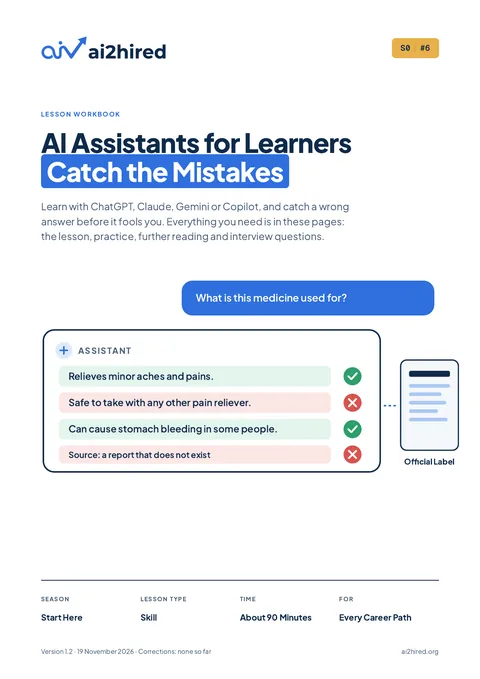
AI Assistants for Learners: Catch the Mistakes
Learn with AI assistants like ChatGPT and Claude, and catch their mistakes: why they hallucinate, and five steps to check any answer at an official source.
PDF31 pagesVersion 1.219 November 2026
Peek Inside
Check Yourself
ChatGPT is best described as:
- A model
- A product built around a model
- A search engine
You ask the same question twice and get two different answers. Why?
An open question: you write your own answer.
Interview Question
How do you use AI tools in your day-to-day work or studies?
Model answerI use ChatGPT and Claude as tutors: I ask for a simple explanation, ask follow-ups, then check the key facts at the official source. For example, I checked an assistant's answer about a medicine against its label and found three wrong claims, so I always verify facts before I rely on them.
Word for word from the workbook. The answers to Check Yourself, and everything else, are inside.
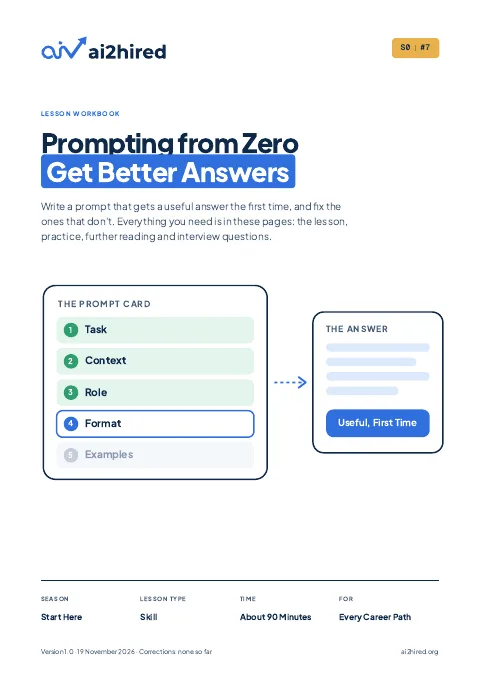
Prompting from Zero: Get Better Answers
Prompt engineering from zero: fill a five-slot prompt card (task, context, role, format, examples), use few-shot examples, and fix a prompt that fails.
PDF29 pagesVersion 1.019 November 2026
Peek Inside
Check Yourself
A prompt is best described as:
- Your question only
- Everything you give the model to work from
- The assistant's answer
Name the five slots of the prompt card, in order.
An open question: you write your own answer.
Interview Question
How would you improve a prompt that gives inconsistent answers?
Model answerFirst I make it specific: a clear task, the context, and an exact format, so less is left to chance. Then I add two or three varied examples of the answer I want, which is few-shot prompting. Then I test it on several inputs and change one thing at a time, so I know which change helped.
Word for word from the workbook. The answers to Check Yourself, and everything else, are inside.
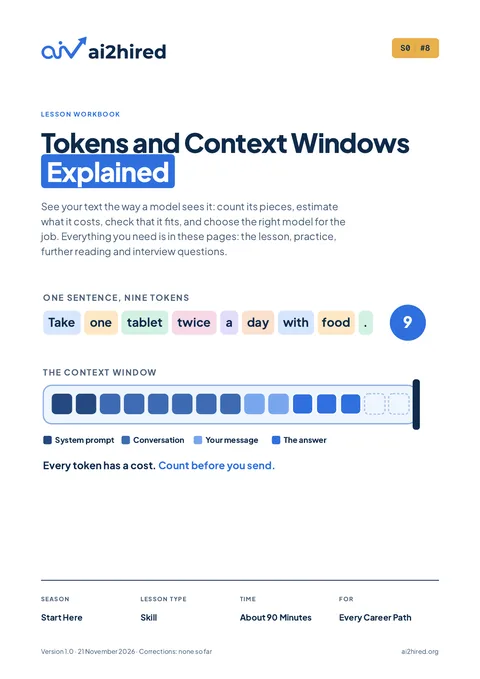
Tokens and Context Windows Explained
What tokens are, why they set the cost of an AI model, how a context window fills up, and how to choose between closed and open-weight models.
PDF30 pagesVersion 1.021 November 2026
Peek Inside
Check Yourself
A token is best described as:
- Always one word
- A piece of text a model reads and counts
- One letter
What two jobs does a tokenizer do on the way in?
An open question: you write your own answer.
Interview Question
What is a token, and why does it matter for cost and context length?
Model answerA token is the piece of text a model reads and writes, counted by that model's own tokenizer: often a word, sometimes part of one. Providers bill per token, with output usually costing more than input. And the context window limits how many tokens fit at once: the prompt, the history and the answer together.
Word for word from the workbook. The answers to Check Yourself, and everything else, are inside.
S1Season 1: Computer and Internet FoundationsGet comfortable with Linux and the command line, and understand how software talks over the internet.Next up
How a Computer Works
Its workbook arrives on the day the lesson is published. Subscribe on YouTube to know when it is out.
Still to come in this season
- S1 · #10 Operating Systems
- S1 · #11 Files, Folders, Paths, Formats
- S1 · #12 The Command Line From Zero
- S1 · #13 Linux Essentials
- S1 · #14 How the Internet Works
- S1 · #15 HTTP From Zero
- S1 · #16 JSON and YAML
- S1 · #17 Your Code Editor
Each workbook arrives on the day its lesson is published.
S2Season 2: PythonRead, write, test and debug Python with confidence, including code written by AI.17 lessons coming
The lessons in this season
- S2 · #18 Install Python, First Script
- S2 · #19 Variables, Types, Operators
- S2 · #20 Strings and f-strings
- S2 · #21 Lists, Dicts, Tuples, Sets
- S2 · #22 Conditionals and Loops
- S2 · #23 Functions
- S2 · #24 File I/O and Parsing
- S2 · #25 Errors and Exceptions
- S2 · #26 Modules, Packages, Dependencies
- S2 · #27 Classes and Objects
- S2 · #28 Type Hints and Pydantic
- S2 · #29 Reading Code You Didn't Write
- S2 · #30 Calling Web APIs in Python
- S2 · #31 Async Python
- S2 · #32 High-Concurrency Python
- S2 · #33 Testing With pytest
- S2 · #34 Mini-Project: A CLI Tool
Each workbook arrives on the day its lesson is published.
S3Season 3: Git and GitHubWork like a professional engineer, with version control, code review and automated checks.6 lessons coming
The lessons in this season
- S3 · #35 Version Control and Git
- S3 · #36 Branches and Merges
- S3 · #37 GitHub
- S3 · #38 Pull Requests and Code Review
- S3 · #39 CI/CD Introduction
- S3 · #40 A Portfolio-Grade Repo
Each workbook arrives on the day its lesson is published.
S4Season 4: Data FoundationsQuery, clean, model, visualize and govern data, and prepare documents for AI.15 lessons coming
The lessons in this season
- S4 · #41 What Data Is
- S4 · #42 SQL 1
- S4 · #43 SQL 2
- S4 · #44 SQL 3
- S4 · #45 Database Design and PostgreSQL
- S4 · #46 Python Meets SQL
- S4 · #47 NumPy
- S4 · #48 pandas
- S4 · #49 Data Visualization
- S4 · #50 Business Intelligence and Data Storytelling
- S4 · #51 NoSQL
- S4 · #52 Data Engineering Basics
- S4 · #53 The Modern Data Stack
- S4 · #54 Data Governance and Master Data Management
- S4 · #55 Ingesting Messy Documents
Each workbook arrives on the day its lesson is published.
S5Season 5: Math for AIUnderstand the math behind similarity search and model training well enough to reason about models, not just call them.6 lessons coming
The lessons in this season
- S5 · #56 Vectors and Matrices
- S5 · #57 Dot Product and Cosine Similarity
- S5 · #58 Probability and Statistics
- S5 · #59 Derivatives and Gradients
- S5 · #60 Gradient Descent
- S5 · #61 Loss, Softmax, Cross-Entropy
Each workbook arrives on the day its lesson is published.
S6Season 6: Classical Machine LearningBuild, evaluate and track machine learning models for the most common business cases.11 lessons coming
The lessons in this season
- S6 · #62 What Machine Learning Is
- S6 · #63 First Model With scikit-learn
- S6 · #64 Classification
- S6 · #65 Evaluating Models
- S6 · #66 Features and Pipelines
- S6 · #67 Trees and Boosting
- S6 · #68 Clustering and Dimensionality Reduction
- S6 · #69 Time Series and Anomaly Detection
- S6 · #70 Optimization and Simulation
- S6 · #71 Experiment Tracking
- S6 · #72 Project: Predictive Maintenance
Each workbook arrives on the day its lesson is published.
S7Season 7: Deep Learning and TransformersSee how neural networks and large language models work inside.10 lessons coming
The lessons in this season
- S7 · #73 A Neural Network From Scratch
- S7 · #74 PyTorch Fundamentals
- S7 · #75 Training Loop in PyTorch
- S7 · #76 TensorFlow and Keras
- S7 · #77 CNNs and Computer Vision
- S7 · #78 NLP Foundations
- S7 · #79 From RNNs to Attention
- S7 · #80 Transformers Explained
- S7 · #81 Tokenization Deep Dive
- S7 · #82 How LLMs Are Made
Each workbook arrives on the day its lesson is published.
S8Season 8: Harnessing Models (CAM)Call, control and combine commercial and open models in production-grade code.14 lessons coming
The lessons in this season
- S8 · #83 Hugging Face Hub
- S8 · #84 Running Pretrained Models
- S8 · #85 Hardware Realities
- S8 · #86 Open Models on Your Own Machine
- S8 · #87 The OpenAI API
- S8 · #88 The Anthropic API
- S8 · #89 Controlling Generation
- S8 · #90 Production-Grade Calls
- S8 · #91 Project: The Summarizer
- S8 · #92 Prompt Engineering Properly
- S8 · #93 Context Engineering
- S8 · #94 Structured Outputs
- S8 · #95 Multimodal APIs
- S8 · #96 Going Provider-Agnostic
Each workbook arrives on the day its lesson is published.
S9Season 9: Embeddings, RAG and SearchBuild grounded knowledge systems and search engines on company data.16 lessons coming
The lessons in this season
- S9 · #97 Why AI Hallucinates, and How RAG Reduces It
- S9 · #98 Embeddings
- S9 · #99 Vector Search
- S9 · #100 Vector Databases
- S9 · #101 RAG From Scratch, No Framework
- S9 · #102 Chunking Strategies
- S9 · #103 Better Retrieval
- S9 · #104 Grounding and Citations
- S9 · #105 LangChain and LlamaIndex
- S9 · #106 Advanced RAG
- S9 · #107 Knowledge Graphs and GraphRAG
- S9 · #108 Building an Enterprise Knowledge Base
- S9 · #109 Search and Recommendation Systems
- S9 · #110 Semantic Caching
- S9 · #111 Text-To-SQL
- S9 · #112 Project: HR Policy Assistant
Each workbook arrives on the day its lesson is published.
S10Season 10: Agents and Tool UseDesign, build and supervise single and multi-agent systems, and use coding agents professionally.16 lessons coming
The lessons in this season
- S10 · #113 Workflows vs Agents
- S10 · #114 Tool Calling From Scratch
- S10 · #115 The Agent Loop
- S10 · #116 Agent Memory and State
- S10 · #117 Guardrails
- S10 · #118 MCP Explained
- S10 · #119 Build Your Own MCP Server
- S10 · #120 Agent-To-Agent Interoperability
- S10 · #121 Agent Frameworks
- S10 · #122 Multi-Agent Orchestration
- S10 · #123 Human in the Loop
- S10 · #124 Computer-Use and Browser Agents
- S10 · #125 AI Coding Agents for Engineers
- S10 · #126 The Agentic Software Lifecycle
- S10 · #127 Legacy Modernization With AI
- S10 · #128 Project: Data-Analyst Agent
Each workbook arrives on the day its lesson is published.
S11Season 11: Building the Product Around the ModelWrap AI into real services, interfaces and enterprise integrations.9 lessons coming
The lessons in this season
- S11 · #129 FastAPI
- S11 · #130 API Security
- S11 · #131 Quick UIs
- S11 · #132 Web Frontend Basics
- S11 · #133 Beyond Python
- S11 · #134 Scaling the Backend
- S11 · #135 Webhooks and Event-Driven Systems
- S11 · #136 Integrating AI With Enterprise Systems
- S11 · #137 Industrial and Lab Data Systems
Each workbook arrives on the day its lesson is published.
S12Season 12: Deployment and CloudShip AI systems to the cloud and to regulated environments, repeatably.13 lessons coming
The lessons in this season
- S12 · #138 Cloud Fundamentals
- S12 · #139 Docker 1
- S12 · #140 Docker 2
- S12 · #141 Kubernetes Fundamentals
- S12 · #142 AWS for AI
- S12 · #143 GCP for AI
- S12 · #144 Microsoft Azure for AI
- S12 · #145 Enterprise Data and AI Platforms
- S12 · #146 Sovereign AI and Deployment Choices
- S12 · #147 Infrastructure as Code
- S12 · #148 Full CI/CD
- S12 · #149 Serving Models at Scale
- S12 · #150 Project: Deploy the RAG App
Each workbook arrives on the day its lesson is published.
S13Season 13: LLMOps: Evaluation, Observability, CostProve an AI system works, keep it reliable and keep its cost under control.11 lessons coming
The lessons in this season
- S13 · #151 Why Evaluation
- S13 · #152 Evaluation Methods
- S13 · #153 Evaluating Agents
- S13 · #154 Observability and Tracing
- S13 · #155 Production Monitoring
- S13 · #156 Product Analytics
- S13 · #157 Cost Governance
- S13 · #158 AI Gateways
- S13 · #159 MLOps, LLMOps, AgentOps
- S13 · #160 Batch Processing
- S13 · #161 Auditing AI You Didn't Build
Each workbook arrives on the day its lesson is published.
S14Season 14: Security, Safety and GovernanceMake AI systems secure, compliant and governable, including in regulated industries such as pharma.12 lessons coming
The lessons in this season
- S14 · #162 AI Security Threats
- S14 · #163 Securing Agents and MCP
- S14 · #164 Guardrail Frameworks
- S14 · #165 The Agent Trust and Autonomy Ladder
- S14 · #166 Data Privacy
- S14 · #167 The EU AI Act
- S14 · #168 AI and the Law Beyond the AI Act
- S14 · #169 AI in Regulated Industries
- S14 · #170 Governance Frameworks
- S14 · #171 Responsible AI
- S14 · #172 Red Teaming
- S14 · #173 Running an AI Governance Program
Each workbook arrives on the day its lesson is published.
S15Season 15: Customizing and Building ModelsAdapt, optimize and train models, up to the research frontier.12 lessons coming
The lessons in this season
- S15 · #174 Prompting vs RAG vs Fine-Tuning
- S15 · #175 Preparing Fine-Tuning Data
- S15 · #176 LoRA and QLoRA
- S15 · #177 Preference Tuning
- S15 · #178 Model Optimization
- S15 · #179 Small Models and Edge AI
- S15 · #180 Training at Scale
- S15 · #181 The Advanced ML Toolbox
- S15 · #182 Scientific AI
- S15 · #183 Build an LLM From Scratch 1
- S15 · #184 Build an LLM From Scratch 2
- S15 · #185 Reading AI Papers
Each workbook arrives on the day its lesson is published.
S16Season 16: AI Business, Product and TransformationFind, justify, deliver and scale AI inside an organization, and lead the people who do it.25 lessons coming
The lessons in this season
- S16 · #186 Digital Transformation Fundamentals
- S16 · #187 Finding AI Use Cases
- S16 · #188 The AI Business Case
- S16 · #189 Build vs Buy vs Partner
- S16 · #190 From PoC to Production
- S16 · #191 AI Product Management
- S16 · #192 Designing AI Product Experiences
- S16 · #193 Agile for AI Teams
- S16 · #194 Program and Project Management for AI
- S16 · #195 Change Management and Adoption
- S16 · #196 No-Code Automation and RPA
- S16 · #197 Power Platform and Copilot Studio Hands-On
- S16 · #198 Enterprise AI Assistants
- S16 · #199 AI for Business Analysts
- S16 · #200 Documentation That Gets AI Shipped
- S16 · #201 Lean, Six Sigma and Process Mining
- S16 · #202 Innovation Management and Tech Scouting
- S16 · #203 AI Strategy and Operating Models
- S16 · #204 Enterprise and Solution Architecture for AI
- S16 · #205 AI Across Industries
- S16 · #206 Deep Dive: AI in Pharma and Life Sciences
- S16 · #207 Customer-Facing AI Roles
- S16 · #208 The AI Consulting Craft
- S16 · #209 Leading AI Teams
- S16 · #210 Talking AI to Executives
Each workbook arrives on the day its lesson is published.
S17Season 17: Getting HiredTurn your skills into proof, visibility and a signed offer.14 lessons coming
The lessons in this season
- S17 · #211 Choose Your AI Role: Decode Any Job Ad
- S17 · #212 Portfolio Project 1: Deployed RAG Knowledge System
- S17 · #213 Portfolio Project 2: MCP Agent for GitHub and Slack
- S17 · #214 Portfolio Project 3: Evaluated, Observed App With Cost Dashboard
- S17 · #215 Capstone: Enterprise RAG
- S17 · #216 Capstone: Autonomous Multi-Agent Coder
- S17 · #217 Your AI CV
- S17 · #218 Build in Public
- S17 · #219 Networking
- S17 · #220 Certifications Worth Your Time
- S17 · #221 System Design Interviews
- S17 · #222 Coding Interviews in the AI Era
- S17 · #223 Case Study and Business Case Interviews
- S17 · #224 Behavioral Interviews and Negotiation
Each workbook arrives on the day its lesson is published.
How to Get the Most From a Workbook
Four steps, about an hour per lesson.
- 1
Watch the Lesson
Watch the video once, without notes, to see the big picture.
- 2
Download the Workbook
Create your free account once; every workbook is then one click away.
- 3
Practise
Answer Check Yourself, do the exercises, then compare with the answers.
- 4
Say It Out Loud
Answer the interview questions aloud, as if a recruiter were asking.
Your Next Step
Mastered Your Workbooks? Earn Your Free Badge
The workbooks prepare you for the ai2hired credentials. Your first one is AI Foundations: understand AI, the jobs it creates and how to use AI assistants with judgment.
- 1Watch and practise the 8 lessons of Season 0, with their workbooks
- 2Mark each lesson done on its page, so your progress is saved
- 3Pass the season quiz and the final exam, 80% each, retakes allowed
- 4Share your badge on LinkedIn, with a public page employers can verify
8 of 8 lessons are live, 8 with their workbook.
Keep Going Between Lessons
Free tools that use what the workbooks teach.
- Interview QuestionsPractise the questions asked for your target role, with what a strong answer covers.Practise
- Career Quiz7 quick questions to find the AI role that fits you.Take the Quiz
- CV CheckUpload your CV and see which AI roles it fits, and by how much.Check My CV
- Job Ad CheckPaste a job ad and see exactly what to learn.Check a Job Ad
Questions People Ask
Are the ai2hired workbooks really free?
Yes. Every workbook is free. You only need a free ai2hired account to download it, with no payment and nothing to install.
Why do I need an account to download a workbook?
The account keeps your workbooks in one place (My Workbooks), lets you download them again at any time, and saves your progress toward the free credentials. You can delete it whenever you like.
What is inside each workbook?
The lesson written out step by step, Check Yourself questions, exercises with answers, a mini project, the interview questions the lesson prepares you for with model answers, and further reading.
Can I print the workbooks?
Yes. Each workbook is a PDF made to be read on screen or printed on A4 paper.
What happens when a workbook is corrected?
It keeps the same name and gets a new version number, shown on its cover and on this page. Download it again from the lesson page or My Workbooks to get the latest version.
How do the workbooks connect to the free credentials?
The workbooks prepare you for the season quizzes and final exams of the ai2hired credentials. The first one, AI Foundations, covers Season 0: watch the lessons, practise with their workbooks, mark each lesson done, then pass the quiz and the exam.
Never Miss a Lesson
Subscribe on YouTube, or get an email the day each new lesson goes live.