
What AI Really Is: AI vs Machine Learning vs LLMs
About This Lesson
Five words come up in every AI job description: artificial intelligence, machine learning, deep learning, generative AI and large language models. This lesson gives each one its clear place, from zero, in one picture.
You see how early AI ran on rules people wrote, why machine learning learns from examples instead (one spam email shows the difference), what a model and training are, and when plain rules are still the better answer. Then deep learning and why it took off in the 2010s, generative AI, and the large language models behind ChatGPT, which writes one word at a time and is a product, not a model.
The lesson ends with what AI still gets wrong: confident wrong answers called hallucinations, bias learned from the past, and a world that keeps changing after the model was trained. Then you read the five words in real job lines and answer the interview question every AI role can ask.
What You'll Learn
- What artificial intelligence really means, and where you already use it every day
- Machine learning versus rules written by hand, on one spam email
- What deep learning is, and why it took off in the 2010s
- Generative AI and large language models (LLMs): how ChatGPT writes, one word at a time
- Why ChatGPT is a product, not a model
- What AI still gets wrong: hallucinations, bias from the past, and a world that keeps changing
- How these five words appear in real AI job descriptions and in interviews
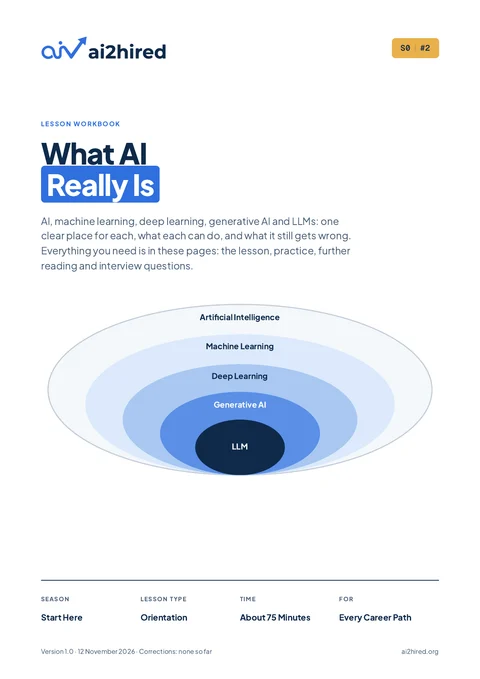
Practise This Lesson on Paper
- The whole lesson, step by step
- Exercises and homework, with answers
- Interview questions, with model answers
- A reading list to go deeper
PDF, 27 pages, Version 1.0
Sources and References
Everything this lesson states was checked against these sources before it was published.
3 Job Postings4 Documents and Papers3 Books2 Further Reading
Job Postings in the Lesson
Good understanding of the stakes and uses of data science, machine learning and artificial intelligence
AI & Data Science Lead, AstraZeneca, Paris region. LinkedIn, 2026; quoted line translated from French.
Expertise in statistical modeling, machine learning, deep learning, and Generative AI
Manager R&I AI & Algorithm, Danone, Gif-sur-Yvette. LinkedIn, 2026, archived posting.
Generative AI and Large Language Models (LLMs)
AI & Data Vice President, AlixPartners, Paris. LinkedIn, 2026.
Official Documents and Papers
- AlphaGo
Google DeepMind, 2016. AlphaGo beats Lee Sedol, March 2016.
- The Nobel Prize in Chemistry 2024, press release
The Royal Swedish Academy of Sciences, 2024. AlphaFold and the 2024 Nobel Prize in Chemistry, 9 October 2024.
- An important next step on our AI journey
Google, 2023. Bard's launch, 6 February 2023, with the demo answer about the James Webb Space Telescope.
- Man is to Computer Programmer as Woman is to Homemaker? Debiasing Word Embeddings
Bolukbasi, Chang, Zou, Saligrama and Kalai, NeurIPS, 2016. Word associations learned from text, and their bias.
The Books Behind This Lesson
This lesson was researched from these books. Read them to go deeper:
 Artificial Intelligence: A Modern Approach
Stuart Russell and Peter Norvig, 4th edition, Pearson, 2020
 Hands-On Machine Learning with Scikit-Learn, Keras and TensorFlow
Aurélien Géron, 3rd edition, O'Reilly, 2023
 AI Engineering
Chip Huyen, O'Reilly, 2025
Further Reading
 Hands-On Large Language Models
Jay Alammar and Maarten Grootendorst, O'Reilly, 2024
 Data Science
John D. Kelleher and Brendan Tierney, MIT Press, 2018
Corrections
None so far. If you spot an error, tell us in the comments under the video or at info@ai2hired.org.
Job postings belong to their companies; ai2hired is not affiliated with them. How sources are chosen and checked.
Transcript
Read the Full Transcript
Five Words, One Clear Place
You hear these words every day: AI, machine learning, deep learning, generative AI and LLMs, and they often get used as if they meant the same thing. By the end of this video, each one will have one clear place, and you'll know what each can do, and what it still gets wrong.
What AI Really Is
This is what AI really is. Let's get into it.
The Big Picture: The AI Family
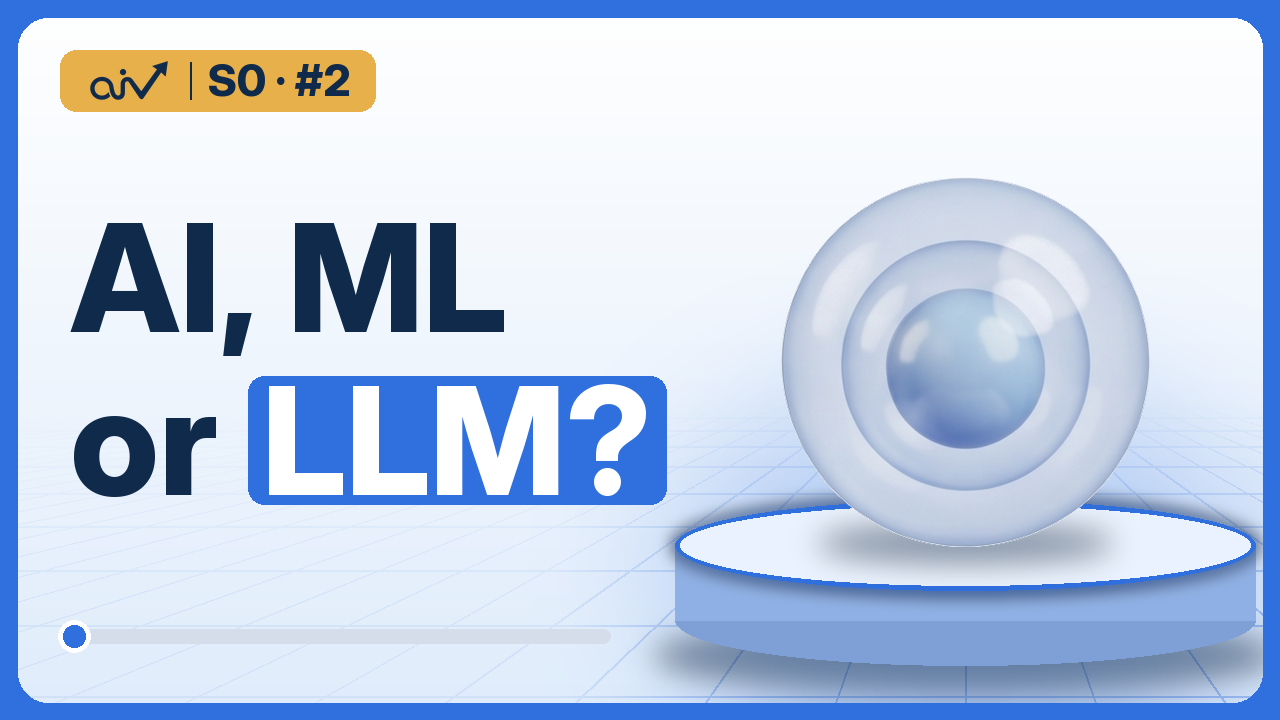
Here's the family of words we're untangling today. The biggest circle is artificial intelligence. Inside it sits machine learning, then deep learning, then generative AI, and right at the center, the large language model. Each circle fits inside the one around it. And this outlined shape is AI agents: systems that act toward a goal, often with an LLM inside, so they reach into the center. We'll leave those for another day.
Today we start from the outside, with AI itself, and work our way in. By the end, these five words you hear everywhere will each have one clear place, and you'll be able to explain them in any interview.
Artificial Intelligence
You already use AI many times a day. When your phone's keyboard suggests the next word, that's AI. When your phone unlocks because it sees your face, that's AI. When a scam email lands in your spam folder instead of your inbox, that's AI too. And when a streaming app seems to know what you want to watch next, you've guessed it, that's AI again. So what is artificial intelligence? It's the field of making machines do tasks that seem to need intelligence, like recognizing a face, translating a sentence, or playing chess.
And here's a surprise: AI doesn't have to copy the human brain. Early inventors tried to fly by copying birds and flapping. Planes only took off once engineers stopped copying the wings and studied the air itself. AI works the same way: it solves the task, whether or not it works like a brain. The comparison is about the method, though, not about how well: planes beat birds at speed, but AI doesn't beat us at everything.
Early AI: Rules People Wrote
In nineteen fifty, the mathematician Alan Turing asked whether machines could think. And the name itself was coined for a summer workshop at Dartmouth College, in nineteen fifty-six. For decades, most AI was built from rules that people wrote by hand. A chess program of that kind followed rules its programmers gave it, and in the seventies and eighties, companies built whole systems from the rules of human experts. They worked, until the world did something the rules didn't expect.
They couldn't learn, they broke easily, and by the late eighties the excitement had collapsed into what people called an AI winter. Why did rules hit that wall? Let's see it with one simple email.
Machine Learning: The Spam Filter
You study the problem, the old way, and you notice that spam loves words like "free" and "4U". So you write a rule: block any email with those words. You test it, it works, and you launch it. Then spammers start writing "For U" instead. Pause for a second, and think: will your rule catch "For U"? No, it won't, because every new trick needs a new rule, and the list keeps growing forever. That's the wall rule-based AI hit, and one big reason for its winter.
The way out came from the next ring of the family. Machine learning is the part of AI that learns from examples, not from rules written by hand. Machine learning flips the job around. Instead of writing rules, you give the computer thousands of examples: emails already marked as spam, or not spam. It finds the clues itself, including ones you'd never think of, and when spammers change their tricks, you give it fresh examples and it learns again.
That's machine learning: learning patterns from examples, then using them on cases it has never seen.
Model and Training
Two words come with this, and you'll hear them everywhere. The learning step is called training, and what you get at the end is called a model. Give the model a new email, and it gives you an answer: spam, or not spam. Remember the engine and the car, from our full map of the course? The model is that engine, the part that does the work.
When Rules Are Still Enough
But that doesn't mean every problem needs machine learning. Finding a city from its postal code needs a simple lookup table, and a rule does it perfectly. Pricing a rental flat is different: size, rooms, neighborhood, floor, the view, all mixed together. Nobody can write that rule by hand, so learning from thousands of real prices does it better. So here's a rule worth keeping for your whole career. Use the simplest tool that solves the problem.
Deep Learning, and Why It Took Off
One ring further in, there's deep learning, the part of machine learning that changed everything. It's machine learning built from many layers of simple, adjustable units, called artificial neurons. Stacked together, they form a neural network. Each layer turns what it receives into a slightly more useful description, and passes it on. With a photo, an early layer might pick out edges, a later one shapes, and a later one still, a whole face.
The more layers, the more complex the patterns it can find, and that's where the word "deep" comes from. The idea of neural networks goes back to the nineteen forties. So why did deep learning only take off around twenty twelve? Three things arrived together: first, lots of data, from the internet. Second, chips built for video games, called GPUs, turned out to do exactly the math that training needs. We'll open one up in the lesson on how a computer works, in Season one.
And third, better training methods made deep networks actually work. In twenty twelve, the results started coming fast: a deep learning system made a sudden leap at recognizing objects in photos. In twenty sixteen, DeepMind's AlphaGo beat one of the world's best players at Go, a board game with more possible positions than there are atoms in the universe. And for medicine, this one matters most. DeepMind's AlphaFold learned to predict the shape of proteins from their building blocks, a problem biologists had worked on for fifty years.
Knowing a protein's shape helps scientists understand diseases and design new medicines, and in twenty twenty-four, that work won a share of the Nobel Prize in Chemistry.
Generative AI
So far, our models have been choosing. The spam filter chooses between two answers: spam, or not spam. Generative AI does something different: it creates new content, like text, images, music, or code. Ask it for a short email, and it writes one that never existed before. And it's only one part of AI: face unlock and your spam folder aren't generative at all. That's the next ring in. Generative AI is the part of deep learning that creates something new.
Large Language Models
And right at the center of the family sits the large language model, called an LLM for short. An LLM is generative AI for language, and at its heart, it does one thing. It looks at the start of a text and guesses what comes next. Take "My favorite color is..." and guess what comes next. Most likely "blue", or "green", and almost never "car". The model doesn't know your favorite color. It knows which words usually follow.
Then it adds that word, guesses the next one, and the next, until a whole answer is written. That's why it's often called a completion machine. Strictly speaking, it reads and writes in small pieces called tokens, which we'll open up in the lesson on tokens, later in this season. So how does it learn to guess so well? From huge amounts of text, and every sentence is a little lesson on its own. Here's an example: "Take this tablet with a glass of water".
Hide the next word and guess it, then the next one, and the one after that. One sentence becomes a whole set of guessing exercises, and the answers are already in the text, so nobody has to label anything. Do that with billions of sentences, and you get a model that writes like a person. And here's a mix-up almost everyone makes: ChatGPT is not a model.
ChatGPT Is a Product, Not a Model
Remember the engine and the car from a few minutes ago? This time, the car has a name. Under the hood, there's a model, the engine doing the guessing. When ChatGPT launched in November twenty twenty-two, it ran on one model, and since then that engine has been replaced by newer ones many times. ChatGPT itself is the product around it, the app you type into, and it's made by OpenAI. The name on the app never changed, but the engine inside did.
So when someone says "the ChatGPT model", they're mixing up the car and the engine. And there it is, the whole family.
The Whole Family
AI is the big umbrella, and machine learning is the part that learns from examples. Deep learning does it with many layers, generative AI creates new content, and the LLM is generative AI for language. Here's one honest note, though: this is a useful picture of the family, not a strict law. A few older methods that create content don't use deep learning at all. But as a map of the words you hear every day, it holds.
What AI Still Gets Wrong
Time for the honest part: what AI still gets wrong. First, it can be confident and wrong. In February twenty twenty-three, Google showed its new chatbot, then called Bard, in a launch demo. It said a new space telescope took the very first pictures of a planet outside our solar system. It sounded certain, but a different telescope had done that back in two thousand four. And when the error was reported, Google's parent company lost about a hundred billion dollars in market value in a single day.
A confident answer that's false has a name: a hallucination. It happens because an LLM gives the likely answer, not a checked one. So when the facts matter, check them. Second, it repeats the past, because a model learns from data people already produced, including its unfairness. In twenty sixteen, researchers found that a language system trained on millions of news articles had learned to link "nurse" with women, and "computer programmer" with men.
Nobody programmed that in: it was simply in the text. Third, the world keeps changing, but a trained model doesn't. It only knows what was in its data when it was trained. Ask about a medicine approved last month, and a model trained a year ago simply has never heard of it. That's why models have to be trained again, or given fresh information, to stay useful.
Two Myths
And now, two myths you'll often hear about AI. The first one says AI runs itself. It doesn't: people choose the problem, prepare the data, and judge the result. The second one says AI always needs big data. Often the right data matters more than more data, and remember the postal code: sometimes the best answer needs no learning at all.
The Five Words in Real Job Lines
So why do these words matter for your career? Because employers use them, every day. Here's a line from an AstraZeneca posting near Paris. Good understanding of the stakes and uses of data science, machine learning and artificial intelligence. After today, two of those three words already mean something precise to you. And this one, from a Danone role near Paris. Expertise in statistical modeling, machine learning, deep learning, and Generative AI.
Expertise takes years, and that's what the rest of this path is for. Today, you can read the line and know exactly what it's asking for. And one more, from an AlixPartners role in Paris: Generative AI and Large Language Models.
The Interview Question
And these words come up in interviews too. "What's the difference between AI, machine learning, and deep learning?" is a classic warm-up question, and now you can answer it in one picture.
Recap
Here's the quick recap, starting with AI, the umbrella: machines doing tasks that seem to need intelligence. Machine learning learns from examples instead of rules, deep learning does it with many layers, generative AI creates new content, and an LLM is generative AI for language. ChatGPT is a product, with a model inside. And AI can still hallucinate, repeat the past, and fall behind a changing world. Five words, one family, and now, one clear place for each.