
Learn AI to Get Hired: The Full Map
About This Lesson
This is where the path starts. In eight minutes you see the whole course: who it is for, where it ends, and how every lesson is chosen.
Most AI jobs never touch the model itself. Researchers build the engine; AI engineers and the roles beside them build the car around it: the apps, assistants and tools people actually use. The course aims at those jobs, and it takes the skills they need straight from real job descriptions.
You also get an honest answer to the degree question, the one rule that holds the course together (nothing is used before it is taught), the 18 seasons told as one learner's journey, and three ways to follow the path for your own role.
What You'll Learn
- What AI jobs really are: building the AI model versus building the product around it
- Whether you need a computer science degree to work in AI
- Where every lesson comes from: real job descriptions
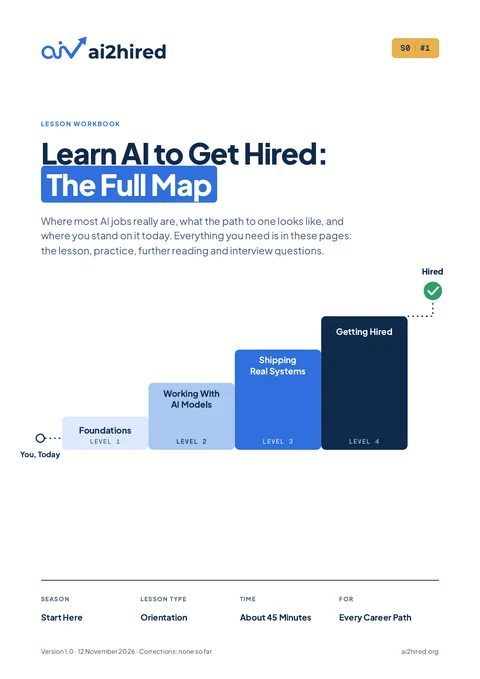
- The full AI learning roadmap: 18 seasons in four levels, from zero to hired
- Three ways to follow the path: the whole path, your role's path, or one lesson when you need it
Practise This Lesson on Paper
- The whole lesson, step by step
- Exercises and homework, with answers
- Interview questions, with model answers
- A reading list to go deeper
PDF, 20 pages, Version 1.0
Sources and References
Everything this lesson states was checked against these sources before it was published.
2 Job Postings1 Further Reading
Job Postings in the Lesson
Very few profiles have already done exactly this job.
Manager, AI Solutions and Transformation, Pyl.Tech, Paris. LinkedIn, 2026; quoted line translated from French.
Very strong command of Python.
Lead AI Engineer, EFOR, Paris. LinkedIn, 2026; quoted line translated from French.
Further Reading
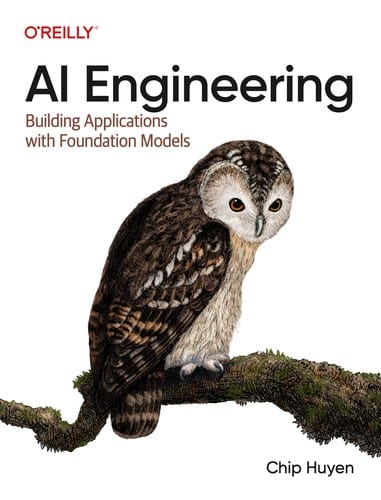 AI Engineering
Chip Huyen, O'Reilly, 2025
Corrections
None so far. If you spot an error, tell us in the comments under the video or at info@ai2hired.org.
Job postings belong to their companies; ai2hired is not affiliated with them. How sources are chosen and checked.
Transcript
Read the Full Transcript
Welcome to ai2hired
Hi, and welcome to ai2hired. Here's where this channel takes you. From not knowing how a computer works, all the way to walking into your AI job interview with confidence. In this video, you'll see the whole journey, from your very first step to your next job. This is the full map, from zero to hired. Let's get into it.
The Big Picture
First, who is this for? Maybe you've never written a line of code. Maybe you work in a completely different field, and AI keeps showing up in the job ads you read. This channel starts from zero, with no code and no technical background needed, and it ends in one clear place, a job. Along the way, you'll learn the skills employers actually list, build real projects that prove them, and prepare your CV and your interviews for the jobs you want.
The AI World: The Engine and the Car
So what kind of AI jobs are we talking about? Think of a car. Inside it, there's an engine. In AI, the engine is the AI model, the part that has learned from huge amounts of examples to write, talk, or recognize images. The people who build new engines are researchers. Their work means new models, deep math, and often an advanced degree. But an engine alone takes nobody anywhere. Someone has to build the car around it, the app, the assistant, or the tool that people actually use.
Those builders are AI engineers, and many other roles work right beside them. This channel is mostly about building the car.
Do You Need a Degree?
So, do you need a computer science degree? Some postings do ask for one. But listen to this line, from a real AI job in Paris. We know that AI career paths are still being built, and that very few profiles have already done exactly this job. The same posting says it's interested in people from consulting, product, and other backgrounds. What you can't skip is the fundamentals, so this path starts right there.
Where Every Lesson Comes From
Every lesson on this channel starts the same way, with a line from a real job description. Like this one, from a lead AI engineer job in Paris. Very strong command of Python. Python is the programming language AI jobs ask for most, so somewhere on this path, there's a lesson that teaches exactly that skill. Keep this line in mind, because we'll find its place on the map in a moment.
The One Rule
And one rule holds the whole path together. Nothing is used before it's taught. If a lesson needs something, an earlier lesson teaches it first, so you'll never meet a new word without its explanation.
The Journey: 18 Seasons, 4 Levels
Here's the whole journey, in one picture. Eighteen seasons, grouped into four levels. It all begins with the foundations. Right here, in this first season, you'll see what AI really is, which jobs exist, and which one fits you. Then you'll discover how a computer and the internet actually work, and how professionals give a computer their commands. From there, you start writing Python. Remember that job line? This is exactly where you learn it.
You'll write code, test it, and fix it, even code an AI wrote for you. Next comes Git and GitHub, so every version of your work is saved and shared, and you'll never again have a file called final, final, version three. After that, you'll work with data, where companies keep it, how to ask it questions, and how to turn it into charts people understand. And to close the foundations, you'll get the math behind AI, with intuition first, so you understand how models learn instead of just pressing buttons.
With those foundations in place, you start working with AI models. You'll build your first models, programs that learn from examples instead of rules. You'll look inside the AI behind tools like ChatGPT. And you'll learn to use the most powerful models in your own code. Then comes the level that turns a demo into a real system, shipping. You'll teach an AI to answer from your own documents, and build AI that takes actions with tools, under your supervision.
You'll turn it all into real apps, put them live for real users, prove they work and keep their cost under control, make them safe and lawful, and even learn to adapt the models themselves. Alongside all of this runs a business track, for the roles that find AI projects in a company, justify them, and lead the people who build them. And it all ends where you want to be, getting hired, with your portfolio, your CV, your visibility, and every kind of interview, right up to negotiating your offer.
That's the whole journey, from your first step to your next job.
Who's Behind ai2hired
Before we go further, let me tell you who's behind this channel. ai2hired is directed by Parham Akhlaghi. Parham works where pharmaceutical R&D meets artificial intelligence, with more than ten years in pharmaceutical and nutraceutical R&D. He has proven, in real labs, that AI makes R&D faster and leaner. Today he guides companies from AI ambition to AI results. So here's how this channel works. Parham designs the curriculum from real job postings, and signs off every lesson.
The lessons are produced with AI, including the voice you're hearing right now. Every fact is checked against sources, the sources are in the description, and if we ever get something wrong, the correction gets pinned. Human-directed, AI-produced, and checked before it ever reaches you.
How to Follow the Path
So, how do you follow it? There are three ways. You can take the whole path, season by season, from the very beginning. Or you can follow your role's path, since each job needs only some of these seasons, and the next lessons help you choose your role. And if you just need one lesson, jump right in. Every lesson works on its own, so you can start anywhere. And wherever a lesson teaches a skill, you'll build a real project, and leave with a new line for your CV.
Recap
Here's the quick recap. Eighteen seasons, in four levels, take you from the foundations to working with AI models, to shipping real systems, and finally to getting hired. Every lesson starts from real job descriptions, and nothing is used before it's taught. And it all leads to one goal, your next job.