
Escape Tutorial Hell: Learn by Building
About This Lesson
You can watch hours of tutorials and still freeze in front of a blank page. This lesson explains why, and gives you a simple weekly routine that makes what you learn stay, for this course and everything after it.
It starts with Maya, who watched forty hours of lessons and couldn't write a first line, and with a study at UCLA where 13 of 54 people knew where the nearest fire extinguisher was in their own building. Familiar is not the same as remembered: that is the illusion of knowing, and watching an AI solve a problem is the new version of it.
Then the habits with real evidence behind them: retrieval practice (79% vs 92% in one middle school), spaced practice, and why learning that feels hard often lasts, with one myth to drop. You learn to build first, to think before you ask when you're stuck, and to keep a five-minute learning log, and the lesson puts it all into one week: learn, build, log, quiz yourself, revisit.
What You'll Learn
- What tutorial hell is, and why watching feels like learning
- The illusion of knowing, and the fire extinguisher study that shows it
- Retrieval practice: the study habit with the most evidence behind it
- Spaced practice, and why learning that feels hard often lasts
- Why learning styles are a myth you can drop
- Build first, and what to do when you're stuck: think first, then ask
- The learning log: four questions and one line in your own words
- One weekly routine that puts it all together
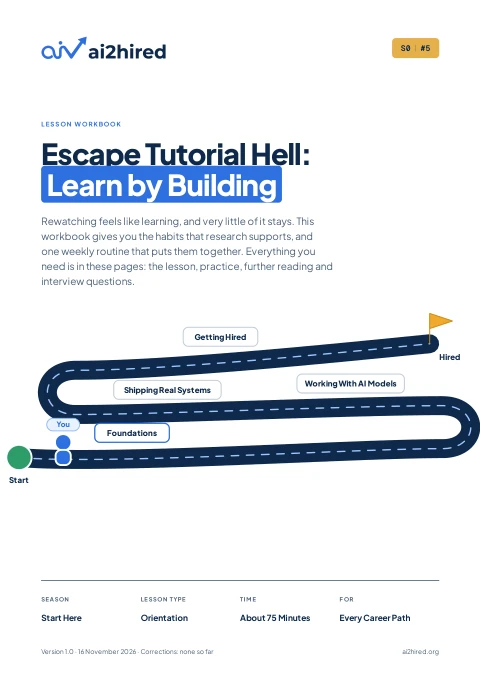
Practise This Lesson on Paper
- The whole lesson, step by step
- Exercises and homework, with answers
- Interview questions, with model answers
- A reading list to go deeper
PDF, 28 pages, Version 1.0
Sources and References
Everything this lesson states was checked against these sources before it was published.
3 Documents and Papers2 Books1 Further Reading
Official Documents and Papers
- Fire drill: Inattentional blindness and amnesia for the location of fire extinguishers
Castel, Vendetti and Holyoak, Attention, Perception, & Psychophysics, 2012. 54 people who worked in the same building; 13 knew where the nearest fire extinguisher was.
- Test-Enhanced Learning in a Middle School Science Classroom
McDaniel, Agarwal, Huelser, McDermott and Roediger, Journal of Educational Psychology, 2011. Averages of 79% on material taught the usual way and 92% on quizzed material, as summed up in Make It Stick (2014), p. 35.
- Learning Styles: Concepts and Evidence
Pashler, McDaniel, Rohrer and Bjork, Psychological Science in the Public Interest, 2008. No adequate evidence that teaching to a learning style improves learning.
The Books Behind This Lesson
This lesson was researched from these books. Read them to go deeper:
 Make It Stick: The Science of Successful Learning
Peter C. Brown, Henry L. Roediger III and Mark A. McDaniel, Harvard University Press, 2014
 Introduction to Generative AI
Numa Dhamani and Maggie Engler, 2nd edition, Manning, 2026
Further Reading
 AI Engineering
Chip Huyen, O'Reilly, 2025
Corrections
None so far. If you spot an error, tell us in the comments under the video or at info@ai2hired.org.
Job postings belong to their companies; ai2hired is not affiliated with them. How sources are chosen and checked.
Transcript
Read the Full Transcript
Forty Hours of Lessons, and a Blank Page
You can watch a hundred hours of lessons and still freeze in front of a blank page, and it has nothing to do with how smart you are. By the end of this video, you'll have a simple weekly routine that makes what you learn stay, so every hour you put into this course keeps paying you back.
Escape Tutorial Hell: Learn by Building
This is how to escape tutorial hell and learn by building, the lesson that makes every other lesson work. Let's get into it.
The Big Picture: The Road to Hired
Here's the whole climb from where you stand today to a signed job offer, one long road up through eighteen seasons of lessons. It starts with the foundations, the basics that every later season is built on. Then comes working with AI models, where you learn how they work and how to use them well. After that you move on to shipping real systems, the part where your work goes out to real users. And the last stretch is getting hired, where you pick a target role, build your proof and walk into interviews.
Today's lesson doesn't add a new stop to this road, because it's about you, and about the way you travel every part of it. Today we'll build your weekly routine one step at a time, so that what you learn at each stop is still with you when you reach the top.
Tutorial Hell: Maya's Forty Hours
Meet Maya, a learner we made up for this lesson, who spent forty hours watching tutorials on Python, the programming language you'll learn in this course. She understood every single one of them, and then she opened a blank page to write a small program of her own and couldn't write the first line. That trap has a name, and it's called tutorial hell, which is when you keep watching lessons and still can't build anything by yourself.
The Fire Extinguisher Study
So why does this happen to careful, hard-working people who really want to learn? A study at a university in California gives us a clue, because the researchers asked fifty-four people where the nearest fire extinguisher was, in the building where they worked every day. Only thirteen of them could say, and some of the others had walked past it for years. Seeing something again and again makes it feel familiar, but familiar is not the same as remembered.
An extinguisher only tests your memory, and a skill takes more than memory, but the trap works the same way.
The Illusion of Knowing
Tutorials do the same thing to you, because when a clear teacher explains something, every step makes sense, and that smooth feeling tells your brain the job is done. Learning researchers call this the illusion of knowing, which is the feeling that you've learned something only because it looks familiar.
What Feels Productive, and What Lasts
Here's the same idea on a simple map, with how productive a habit feels on one side and how long it stays with you on the other. Rewatching a lesson, rereading your notes and highlighting them all feel productive, but very little of what you covered lasts. The habits that stay are the ones that feel slow and clumsy, like testing yourself, explaining an idea out loud or building something on your own.
Watching an AI Solve It
Remember the AI coding tools from our last lesson, the ones that can write a working app in about a minute? They make this trap deeper, because reading a smooth answer from an AI feels exactly like understanding it. So watching an AI solve it is the new watching a tutorial, and it leaves you just as stuck when the page is blank.
Retrieval Practice
So what makes learning stay, if watching it again doesn't? The answer with the most evidence behind it is to close the lesson and pull the idea back out of your own memory. It's called retrieval practice, and it means recalling something without looking, by quizzing yourself or by explaining it out loud.
The Quiz Study: 79% vs 92%
Here's what it does in a real classroom, in a study from an American middle school where researchers added short quizzes on part of the science course for three semesters. On their exams, the students averaged seventy-nine percent on the material that was taught the usual way, and ninety-two percent on the material they had also been quizzed on. These were the same students with the same teacher, and the only thing that changed was that they had to pull the answers out of their own heads.
Spaced Practice
Now let's add time to the picture, because after you learn something your memory of it fades, quickly at first and then more slowly. Each time you recall it, the memory jumps back up, and the next fall is slower than the one before. So you leave gaps on purpose, coming back the next day, then a few days later, and then a week later. This is called spaced practice, which means spreading your recall over time and not doing it all in one sitting.
Effort Is the Signal
There's one catch, and it's the reason most people give up on this method. Recalling feels harder than rewatching, and you'll get things wrong, so it's easy to decide that you're just bad at this. The opposite is true, because the effort of recalling is what strengthens the memory, and learning that feels a little hard is often the kind that lasts. So when you quiz yourself, answer for real, out loud or on paper, before you check the lesson.
If you only think that you know the answer, the illusion of knowing has fooled you one more time.
One Myth to Drop: Learning Styles
One popular idea you can let go of is learning styles, the belief that you're a visual learner or a listening learner and should be taught that way. Studies have found no good evidence that matching lessons to a style helps, so use every route you can, and above all the ones where you do the work.
Build First
Retrieval practice has a bigger brother, and it's the idea this whole course is built on. It's called build first, and it means you try to make the thing yourself before anyone shows you how. Even when your first try is wrong, you learn more from the explanation that follows, because now your brain has a question it wants answered.
One Small Build on Every Level
You don't have to wait until you know everything, either. Remember the four levels on the road we looked at a few minutes ago? On every one of them, you can build something small with only what you know so far. A small thing you finish yourself teaches you more than many more hours of watching. Keep it small enough to finish in a few days, because finished matters far more than impressive.
When You're Stuck: Think First, Then Ask
And when you get stuck, which everybody does, the order of the next two steps matters. First you think it through on your own for a while, because your mistakes show you exactly what you haven't understood yet. Then you ask for help, from a person or from an AI assistant, a chat tool like ChatGPT that answers your questions. Ask it to explain what went wrong and not to do the work for you, and then rebuild it yourself without looking.
The Learning Log
The next tool takes five minutes and a single page, and you use it right after each session, while the work is still fresh. It's called a learning log, which is a notebook where you write down what you did and what you learned from it. It asks you four questions, which are what went well, what went badly, what it reminds you of from things you already know, and what you'll do differently next time. Then you add one last line, the main idea of the session in your own words, written without copying the lesson.
A First Entry
Here's what a first entry could look like, written right after this very lesson. Notice that it's short and honest, and that the last line is something you could say to a friend without your notes. Writing in your own words is retrieval practice again, and linking a new idea to what you already know gives it a place to stay.
Your Weekly Routine
Now let's put the pieces into one week, because a routine only works when it's simple enough to repeat. You learn in short sessions, one or two lessons at a time, and you stop to answer whenever the lesson asks you a question. Right after, you build something small with what you just learned, before you watch anything else. Then you close every session with five minutes in your log, while it's all still fresh. Once a week, you close everything and quiz yourself, on this week and on the weeks before it.
And you revisit only what you got wrong, which is the only rewatching this routine allows.
Maya's Next Week
Remember Maya and her forty hours, from the start of this lesson? Here's her next week with this routine, in which she watches two hours and not ten, and stops each time to try before the teacher shows the answer. She builds one small program of her own, writes a few lines in her log after every session, and on Sunday her quiz shows her two things she had already lost. She watched far less than before, and for the first time the page in front of her is no longer blank.
If you keep only one sentence from today, make it the rule that you learn by retrieving and building, and not by rewatching.
How to Use This Course
This course is built around that rule, so here's how to use each lesson the way it was designed. You've already met the predict moments, where I stop and ask you to guess, so pause the video and really answer before I do. When a lesson ends with a mini project, build it first and only rewatch the part where you got stuck. When the recap starts, pause and try to list the main points yourself, then listen and see what you missed.
A few days later, open the lesson's free workbook, where the quiz questions and flashcards bring it all back one more time. And when a lesson gives you a line for your CV, it's only yours once you can do the task with the video closed.
The One Rule, as a Rule of Memory
There's one more reason the course is built this way, and you already know its one rule, that nothing is used before it's taught. That isn't only a promise about the order of the lessons, because it's also how memory works, and new ideas hold on to old ones. So when a lesson feels impossible, the fix is rarely to push harder, and it's usually to go back and rebuild the idea underneath.
Recap
Here's the short version of everything we covered in this lesson. Tutorial hell comes from the illusion of knowing, where something feels learned only because it looks familiar. What makes learning last is retrieval practice, pulling ideas out of your own memory, spaced over days and weeks, even when it feels harder. So you build first, you write five minutes in your learning log, and once a week you quiz yourself and revisit only what you missed.
That's the whole routine, and it comes down to recalling it, building it and writing it down. The exercises, further reading and interview questions for this lesson are in the free workbook on ai2hired. org, linked in the description. And before the next lesson starts, close this video and write down the three things you remember.