
AI Jobs Explained: Which Role Fits You?

About This Lesson
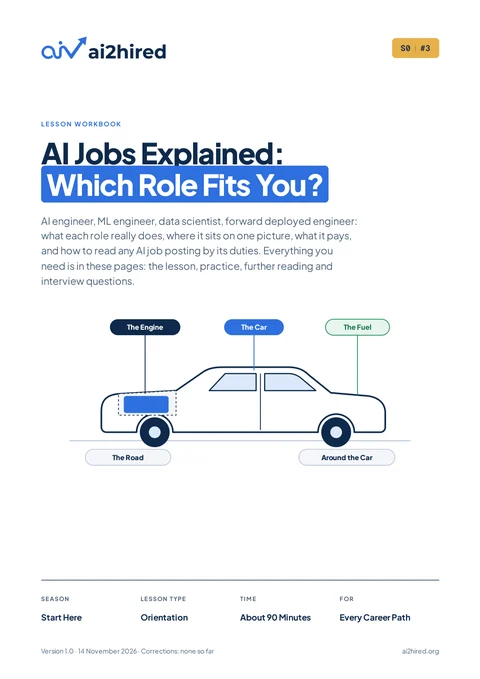
AI engineer, ML engineer, data scientist and forward deployed engineer all sound alike, and companies do not even use those titles the same way. This lesson puts every AI role on one picture, an AI application drawn as a car, so you can tell them apart for good.
It starts with the split behind every AI job: training builds a model, deploying puts it to work, and most jobs are on the deploying side. Then the engine (ML researchers and ML engineers), the car (AI engineers and forward deployed engineers, the fastest-growing title in tech), the fuel (data scientists and the data roles) and the roles around the car (AI product managers and transformation roles), with all sixteen career paths of the course placed on the same car.
The lesson ends with salary reality from real postings in the US and France, and two real job postings read duty by duty, which show why you read the duties, not the title.
What You'll Learn
- The two kinds of AI work, training and deploying, and why most AI jobs are on the deploying side
- ML researcher vs ML engineer: who invents new models and who runs them in real products
- AI engineer vs forward deployed engineer: who builds the application around the model
- What a data scientist, an AI product manager and the transformation roles really do
- All sixteen AI career paths on one picture, and which one fits you
- Real AI salaries from job postings in the US and in France
- How to read a real AI job posting: the duties, not the title
Practise This Lesson on Paper
- The whole lesson, step by step
- Exercises and homework, with answers
- Interview questions, with model answers
- A reading list to go deeper
PDF, 28 pages, Version 1.0
Sources and References
Everything this lesson states was checked against these sources before it was published.
4 Job Postings1 Document or Paper3 Books2 Further Reading
Job Postings in the Lesson
Design and implement data pipelines that transform raw data into valuable insights, ensuring scalability and reliability in cloud environments.
Data & AI Engineer, Sanofi, Paris. Indeed, 2026.
Travel to customer sites across France for executive meetings, workshops, and relationship building
Applied AI Engineer, Enterprise, Anthropic, Paris. Indeed, 2026.
US: $207000 - $300000 (USD) + 20% bonus target + equity + benefits
Staff AI Engineer, Multimodal Agentic AI for Glasses, Google, San Jose. Indeed, 2026.
Data & AI Engineer, Data Scientist and Digital Product Owner (AI agents), Sanofi, Lyon
LinkedIn, 2026, archived postings, salary ranges.
Official Documents and Papers
- One of the fastest-growing jobs in Silicon Valley sends engineers straight to customers’ offices to get AI up and running
Fortune, with Lightcast data, 2026. Forward deployed engineer postings up more than 1,000% from January to August 2026; median advertised salary over $188,000. 3 September 2026.
The Books Behind This Lesson
This lesson was researched from these books. Read them to go deeper:
 AI Engineering
Chip Huyen, O'Reilly, 2025
 Designing Machine Learning Systems
Chip Huyen, O'Reilly, 2022
 Building AI-Powered Products
Marily Nika, O'Reilly, 2025
Further Reading
 Data Science
John D. Kelleher and Brendan Tierney, MIT Press, 2018
 Data Science, AI, and Machine Learning in Drug Development
Harry Yang (editor), Chapman & Hall/CRC, 2022
Corrections
None so far. If you spot an error, tell us in the comments under the video or at info@ai2hired.org.
Job postings belong to their companies; ai2hired is not affiliated with them. How sources are chosen and checked.
Transcript
Read the Full Transcript
Read Any AI Job Posting
AI engineer, ML engineer, data scientist and forward deployed engineer all sound alike, and companies don't even use those titles the same way. By the end of this video, you'll read any AI job posting and know which role it really describes, and which one fits you.
AI Jobs Explained
This is AI jobs explained, the lesson that decodes every AI role. Let's get into it.
The Big Picture: An AI Application as a Car
Remember the engine and the car, from our full map of the course? Here they are again, and this time we look at everyone who works on them. Every AI application starts with its engine, the model, usually one that someone else has already trained. Around it, we build the car. The backend, the code behind the screen, connects the engine to everything else. An engine needs fuel, and here the fuel is the company's data. It fills the trunk as knowledge, the company's own documents, ready to look things up.
Two more parts feed the engine what it needs. The context is the facts the model is handed with each question, and the tools are the actions it can take, like searching the web or sending an email. Orchestration works like the car's navigation, planning each step of the trip, and guardrails and security work like the brakes and the seatbelts, keeping every trip safe. Now the car is ready for its driver. The interface, the screen of the app, works like a dashboard, and in the driver's seat sits the user, the person all of this is for.
Then the car takes the road, where the application is put online, tested every day, and kept affordable. Every AI job works somewhere in this picture, on the engine, in the car, or on the road. Today, we'll take one real job posting and find out which role it really is, and why the title alone can fool you.
Two Kinds of AI Work: Training and Deploying
Before we meet the people, here's a question from our lesson on what AI really is. What do we call the step where a model learns from examples? It's training, and what comes out at the end is the model. That one step is what splits all of AI work into two kinds. Training is how a model gets built. Deploying puts it to work, inside a product that real people use. Training a giant model, like the ones inside ChatGPT, takes huge amounts of data, thousands of powerful chips, and rare experts.
So only a few big companies and research labs can afford it. Everyone else takes those ready-made models and builds with them. That's why most AI jobs sit on the deploying side, and it's exactly where this course is taking you.
Why Pharma Hires Data and AI People
And this matters a lot in pharma. Bringing a new medicine to patients takes many years and costs a fortune, and every step creates data that has to be recorded and checked, from the lab to the patient. So pharma companies need people who can put AI to work on that data, safely.
Building the Engine
Let's start where the AI itself is made, the engine.
ML Researcher
The ML researcher invents new kinds of models, and new ways to train them. In our car, they're the ones who design new engines. Their days are spent reading and writing research papers, running experiments, and working through a lot of math. Many of them hold a PhD, the most advanced university degree. And research wants something different from a real product. A researcher tries to beat the best score on a fixed set of test data, called a benchmark.
A product has to answer fast, on messy data that keeps changing, for people who expect it to work every time. So do you need a PhD to work in AI? Remember the degree question from our full map? A real posting welcomed people from other backgrounds. Here's what's new this time. Research roles often do ask for that degree, but most other AI roles don't, because they sit on the deploying side.
ML Engineer
The ML engineer builds and runs models in production, which means in real products, used by real people. For example, a model that predicts when a machine in a medicine factory is about to break down. The ML engineer prepares the data, trains that model, puts it on servers, the computers that run it online, and watches it every day, so they notice when it starts to slip. So on our car, the ML engineer builds the engine and keeps it running on the road.
The Model Is a Small Box
And here's the surprise of this picture. In a real system, the model is a small box, surrounded by everything that keeps it working. Keeping all of that running reliably has its own name, MLOps, the practices that keep models healthy in production.
Building the Car
Now the car, the application built around the engine.
AI Engineer
The AI engineer builds applications on top of models someone else trained. In the picture, they build the car around an engine someone else made. Instead of training a model from scratch, they connect a ready-made one to a real product. They write the prompts, the instructions the model gets. They give it the company's own documents to look things up in, a setup called RAG. And they test whether its answers are good enough, which is called evaluation.
Two Orders of Work
That turns the usual order of the work upside down. Classic machine learning starts with data, then builds a model, then a product. AI engineering often starts with the product, using a model that already exists, and gathers more data only once the idea proves it's worth it. So do AI engineers need to know how models are trained? Not to start building, but it helps a lot when something breaks, and many teams expect it.
Forward Deployed Engineer
The forward deployed engineer does AI engineering inside the customer's company. Picture an AI company selling its product to a big bank, or a group of hospitals. The demo looks great, and then it meets the customer's old systems, messy data, and strict rules. The forward deployed engineer goes there, often in person, and makes it work, like a mechanic who comes to the customer's garage and fits the car to their roads.
The role started at Palantir, a data software company, and today it's one of the fastest-growing titles in tech. Job postings for the role rose more than a thousand percent from January to August twenty twenty-six, compared with the same months a year earlier. That's from the labor market analysts at Lightcast. And the median advertised salary, the middle of the range, was over a hundred and eighty-eight thousand dollars a year, against about a hundred and forty-five thousand for a regular software engineer.
The Fuel: Data Scientist
Now the fuel, the data that makes the whole car go. The data scientist starts from a real business question and digs for patterns in data that lead to action. For example, which volunteers are likely to drop out of a clinical trial, a study that tests a new medicine on volunteers. If the team spots them early enough, it can help them stay. Data scientists use machine learning methods like tools they know well, without writing them from scratch.
On our car, they study the trips and the fuel to find what should change. The job mixes a lot of skills, like statistics, machine learning, working with data and databases, charts, programming, knowing the field you work in, ethics and the rules, and above all, communication. Nobody masters all of them, and most data scientists go deep in just a few. And results nobody understands never get used, which is why communication belongs on this wheel at all.
Around the Car: AI Product Manager
Now let's step outside the car, where two more roles work around the whole picture. The AI product manager decides what to build, and why, like choosing which car to make and which trips it's for. They sit where business, research and engineering meet, and they spend a lot of time with users. They don't write the code or train the models, but they need real AI knowledge, like what AI can and can't do, when a feature is ready to launch, and which trade-offs are worth making.
Some work close to the model teams and are quite technical, while others add AI features to products that already exist.
Transformation Roles
And around all of this sit the transformation roles, like the digital transformation manager. Digital transformation means changing how a company works with digital tools. These people find where AI can help, bring the teams along, and make sure the change lasts across a whole company. They don't work on one car, they change how the whole company travels.
Sixteen Career Paths, One Car
Now let's put everyone back on the car. Our course has sixteen career paths, and every one of them has a place here. On the engine, AI research invents new kinds of models, and the ML engineer builds and runs them. In the car, the AI engineer builds the application, and the forward deployed engineer makes it work at the customer. The AI architect draws the plan of the whole car before anyone builds it. The AI workflow engineer connects AI to the tools a company already uses, so everyday tasks run on their own.
And the AI security engineer keeps the brakes and the locks working, so no one can trick the AI or steal its data. The fuel has three career paths of its own, all working with data. The data engineer for AI builds the systems that bring clean data in, the data scientist studies the trips, and the data governance lead decides who owns each piece of data and what it means. On the road, the MLOps engineer keeps everything online, tested and affordable, every single day.
And around the car sit five more. The AI product manager chooses which car to build. The AI engineering manager leads the team that builds it. The AI consultant helps a company pick the trips worth taking. The digital transformation manager changes how the whole company travels. And AI governance makes sure every car follows the rules of the road, like the laws on AI. Real teams are messier than this picture, though. In a small company, one person may do three of these jobs at once.
Which Role Fits You?
So which one fits you? If you love math and experiments, look at the engine. If you love building things people use, look at the car. If you'd rather work face to face with customers, forward deployed engineering is made for you. If questions about data excite you, try data science. And if you like deciding what gets built, and why, look at product and transformation roles. You don't have to choose today, because every one of these sixteen paths starts with the same foundations, and each one has its own page on our website, with its exact list of lessons.
Salary Reality
Let's talk about the money, from real postings only. You may have heard that AI engineers make three hundred thousand dollars a year. Here's where a number like that comes from. A Google posting for a staff AI engineer, a senior role that asks for eight years of experience, pays a base of two hundred and seven thousand to three hundred thousand dollars, plus a bonus and shares in the company. So the number is real, but it sits at the top of a senior range in the US.
In France, the numbers look different. At Sanofi in Lyon, a data and AI engineer posting offered forty-eight to seventy-two thousand euros a year, and a data scientist posting fifty-four to seventy-two thousand. A product owner, a role close to the product manager, was offered sixty-four to ninety-six thousand, to work on AI agents, systems that act toward a goal. And at the very top, Anthropic lists an applied AI engineer role in Paris at two hundred and twenty to two hundred and thirty-five thousand euros.
That figure includes a sales bonus, and the role asks for at least six years of experience. The pattern is the same everywhere. The pay follows proof, years of experience and real things you've built, and collecting that proof is exactly what this path is for.
Reading a Real Posting
Time to use all of this on a real posting. Here's one from Sanofi in Paris, and its title is Data and AI Engineer. Read the title, and you'd expect someone who builds AI applications. Now let's read the duties instead. The first duty says, design and implement data pipelines that transform raw data into valuable insights, ensuring scalability and reliability in cloud environments. A data pipeline is the chain of automatic steps that moves and cleans data.
The second says, implement data quality checks and follow governance standards. And the third says, build and maintain ETL processes and machine learning workflows, providing clean AI ready data for our applications. ETL means pulling data out of one place, cleaning it, and loading it into another. Do you notice the pattern here? Almost every duty is about getting data ready, and only one line of the whole posting asks for experience with large language models.
So this job is mostly what's called a data engineer for AI, someone who builds the systems that move, clean and store data, here so the AI can use it. In our car, that's the person who brings in the fuel and keeps it clean. It's a real career path, and a good one, but you'd only see it by reading the duties. Now a second posting, from Anthropic in Paris, titled Applied AI Engineer, almost the same title. Here are two of its duties.
Run executive briefings, technical workshops, and enablement sessions for both leadership and engineering audiences. And, travel to customer sites across France for executive meetings, workshops, and relationship building. It also asks for experience in pre-sales, the technical side of selling. That's much closer to the forward deployed engineer you met earlier, with some selling mixed in, while the Sanofi job was mostly data engineering.
Two AI engineer titles, and behind them, two completely different jobs. So here's a rule for your whole job search. Read the duties, not the title.
Recap
Here's the quick recap of this lesson. AI work splits into training models and deploying them, and most jobs are on the deploying side. ML researchers invent models, ML engineers train and run them, and AI engineers build applications on models others trained. Forward deployed engineers make those applications work inside a customer's company, data scientists turn data into decisions, and product and transformation roles decide what to build and help the company change.
Training builds the engine, and most AI jobs put it to work, where the pay follows proof. The exercises, further reading and interview questions for this lesson are in the free workbook on ai2hired. org, linked in the description. And whatever the title says, read the duties.